


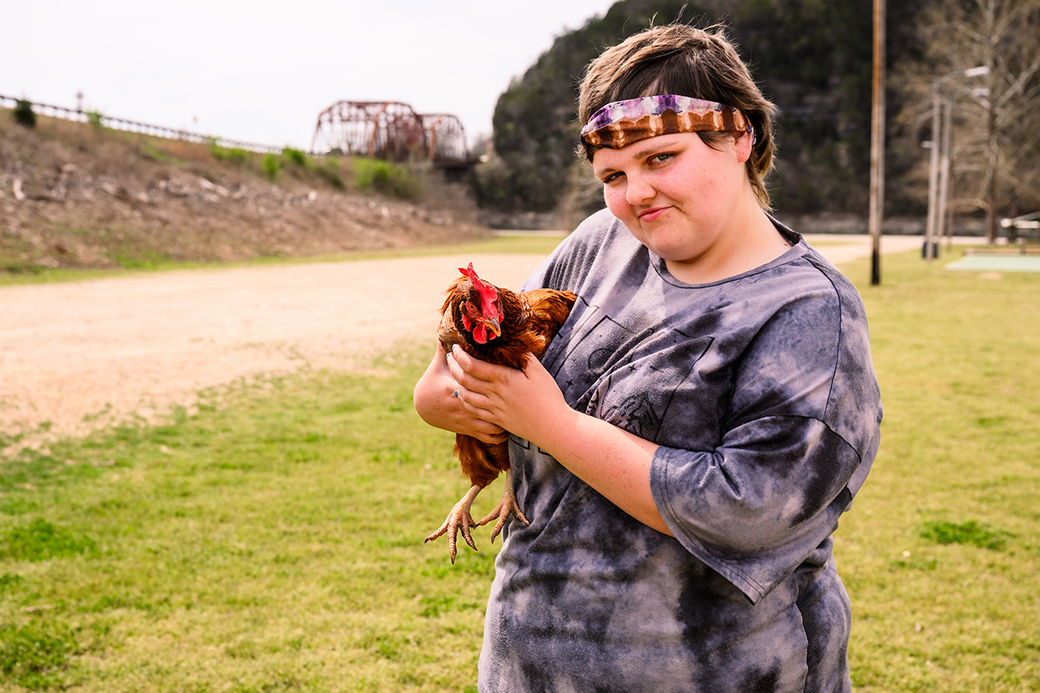
It’s a rare day that Caitlynn Westbrook isn’t spending time with her younger sister and brother, or the family’s flock of eight chickens.
Happy screams and clucks fill the air as humans and birds spend time outside the Westbrook family home in Forsyth, Missouri, a small town nestled on the banks of Lake Taneycomo outside of Branson.
“We love swimming or just driving around on the back roads, looking at the natural beauty,” Caitlynn said. “There’s all these little spots that are hidden around for you to discover.”
Raising chickens and hatching chicks has also been a journey of discovery for the 18-year-old as she grows up. It’s given her responsibility, a sense of purpose and great joy.
“With chickens, it's almost like people watching,” Caitlynn said. “You can just watch them run around, chase bugs, do whatever, and it's the funniest thing ever.”
And like many young people her age, she started learning to drive when she was 15.
She earned her learner’s permit even though she had started experiencing consistent pain in her right leg and hip that would keep her in bed and away from school.
“It was so bad that I couldn’t walk, I couldn’t get up,” Caitlynn said. “I would cry my eyes out. It would keep me bedridden for days.”

She and her mom, Nicole, went to urgent care and tried pain medications. Then they went to her pediatrician in Branson. Scans showed a mass or tumor on her leg, something Caitlynn had worried about privately, but never wanted to say, during the long, painful days in bed.
The doctor sent Caitlynn and her parents to MU Health Care’s Children’s Hospital in Columbia. There, they met with pediatric orthopaedic oncologist Cecilia Belzarena, MD, an expert in bone cancers.
“When Caitlynn came to us, she had a suspected case of a bone infection called osteomyelitis, and she had very high pain levels for months,” Dr. Belzarena said. “We saw signs that this might be more than an infection and did a biopsy, which showed us she had Ewing sarcoma.”
Ewing sarcoma is a rare bone cancer most common in kids and young adults ages 10-20. It is most common in the long bones of the legs and arms, but it can happen in any bone.
“Ewing sarcoma is a bone cancer that can spread elsewhere in the body,” Dr. Belzarena said. “The most common symptom is pain, usually along a bone or near a joint. Pain can also be present for a long time, and some kids may have a lump, be limping or have a fracture, so it's common for this to be mistaken for sports injuries.”
Caitlynn and her family were stunned. Thankfully, Dr. Belzarena and hematologist and oncologist Tyler Severance, MD, had good news: Her sarcoma had not metastasized, or spread, outside of her right tibia, or shin bone.
“The idea of having cancer really scared me,” Caitlynn said. “You hear all these stories about people with cancer in their leg, and they have to lose it. And I was like, ‘I don't want that to be me.’”
Caitlynn started chemotherapy and radiation as quickly as possible to shrink the size of her tumor. Because of her compromised immune system, she kept her distance from the chickens and their coop while back at home. And though she couldn’t be near them, she watched them play in the yard and focused on candling the eggs — using light to see shapes inside of the shell — to check for chicks.
“It took my mind off things, and it was kind of like an anchor to help me stay sane,” Caitlynn said. “Having that joy in my life really helped.”
After a few months of treatment, her Ewing sarcoma had not spread to another part of her body and was the right size for Dr. Belzarena to recommend the next round of treatment.

“At MU Health Care, we have all the treatment options available, and a full team who takes care of kids with cancer like Caitlynn,” Dr. Belzarena said. “Ewing Sarcoma is a rare disease, and we have a very skillful team helping patients and their family overcome this disease. We caught it early enough that we were able to offer an optimized, personalized surgical option for her.”
Dr. Belzarena told Caitlynn and her family that she was a good candidate for surgery that would remove the part of her bone affected by Ewing sarcoma.
Dr. Belzarena planned to submerge the cut piece of her leg bone in liquid nitrogen. At minus-321 degrees Fahrenheit, it is one of the most effective ways to kill cancer. Then, she would carefully place the bone back into Caitlynn’s leg using metal plates and screws.
“I'm really glad that today there's people like Belzarena that can do surgeries like this to save your leg,” Caitlynn said. “When she first described it to me, I was like, ‘How am I supposed to go back to normal life after that?’ But now I'm almost walking normally again.”
After a successful surgery, Caitlynn moved to recovery and then did a final round of chemotherapy to help make sure her cancer stays away.
Her long days at the hospital were brightened by her nurses, visits from facility Duo dogs Link and Blaze as well as music therapists and the child life team. The room was full when Caitlynn had her bell-ringing ceremony in November of 2025 to celebrate officially being in remission.
“Caitlynn’s bone shows signs of healing, and I heard she’s back to taking care of her chickens, so we are really happy for her,” Dr. Belzarena said. “I am honored to be part of this journey with patients like Caitlynn and her family — ultimately this is the reason why I do what I do.”
Caitlynn felt so inspired by her child life team that her goal is to work in child life after graduating high school in May of 2026. She worked hard in physical therapy to make sure she is able to climb the steps and walk across the stage to claim her diploma. Next up — renewing her learner’s permit so that she can get her driver’s license.
“There was a point in my journey where I was so sick, I was just done,” Caitlynn said. “I'm glad that I kept going. I’m glad I kept fighting. Sometimes, I'll be walking and I forget that I ever had surgery, and it’s like it never even happened.”